How to choose auto tools for safer maintenance and diagnostics
a[data-rs-seo-link]{text-decoration:underline!important;color:#1a56db!important;cursor:pointer!important;}a[data-rs-seo-link]{text-decoration:underline!important;color:#1a56db!important;cursor:pointer!important;}
Quick answer for building a useful auto tools kit
Choosing auto tools is not about buying the largest set. It is about matching tools to the maintenance, repair, and diagnostic work the garage actually handles. A reliable kit should cover four needs: basic fastening, safe lifting and wheel service, measurement and inspection, and diagnostics. For modern vehicles, sockets and wrenches are only part of the plan. A torque wrench, tire pressure gauge, jack stands, multimeter, scan tool, lighting, gloves, and safe storage can be just as important as a large ratchet set.
The practical rule is straightforward: buy by task, confirm the vehicle’s service information, and do not use a tool outside its design purpose. That approach helps reduce broken fasteners, poor diagnosis, damaged parts, and avoidable safety risks. For related workshop topics, see the Tools and Accessories section.
Start with the job, not the tool count
Many tool lists start with a number: 100 pieces, 200 pieces, or more. That number can be misleading because duplicate bits, rarely used sockets, and low-value accessories inflate the count. A better auto tools plan starts with the work the garage expects to perform.
Routine maintenance
Routine work includes oil changes, air filters, cabin filters, batteries, wiper blades, tire pressure checks, spark plugs on accessible engines, and simple inspections. These jobs usually need hand tools, drain and fluid handling tools, gloves, lighting, and basic measuring tools. They do not always require specialty equipment, but they do require correct socket sizes, safe access, and a way to avoid over-tightening.
Repair and replacement work
Brake service, suspension repairs, belts, hoses, starters, alternators, and wheel service require a stronger tool selection. At this level, a floor jack and jack stands, breaker bar, torque wrench, pry bars, line wrenches, pullers, and application-specific sockets become more important. The key difference is load and risk: parts may be seized, heavy, spring-loaded, hot, or safety critical.
Diagnostics
Diagnostic work is more than reading fault codes. It involves confirming symptoms, checking voltage, inspecting connectors, comparing live data, and separating a failed component from a wiring, sensor, or mechanical condition. A basic scan tool and digital multimeter can help prevent unnecessary part replacement, but they need to be used with service information and a clear test plan.
Core hand tools still carry most of the workload
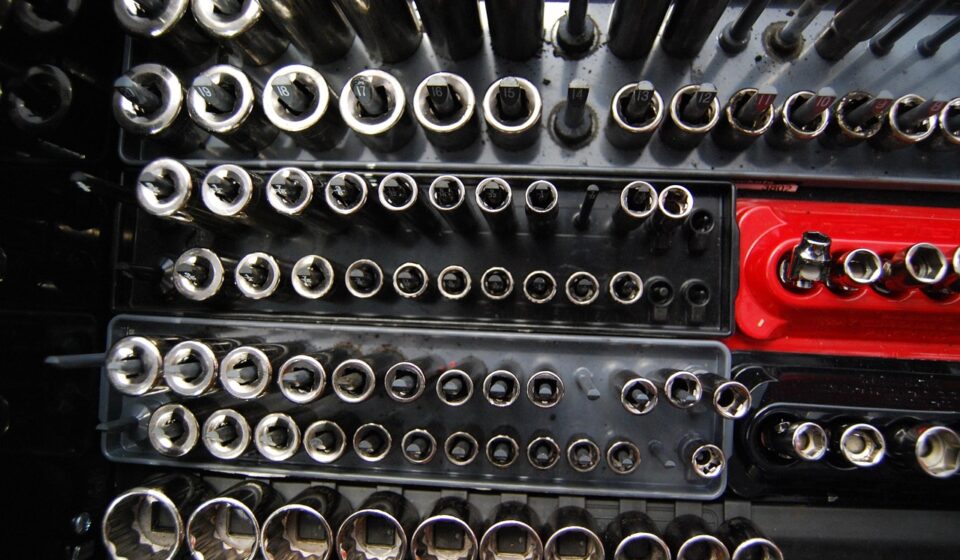
Even as vehicles become more electronic, most maintenance still begins with hand tools. A useful automotive hand tool set should include metric socket sets, ratchets in common drive sizes, combination wrenches, screwdrivers, hex and Torx bits, pliers, trim tools, extensions, universal joints, and a breaker bar. For many passenger vehicles, metric tools see more use than SAE sizes, although older vehicles, aftermarket parts, and some specialty equipment can still require SAE tools.
Tool fit matters. A poor-fitting wrench or worn socket can round a fastener and turn a routine job into a drilling, extraction, or replacement problem. Six-point sockets are often preferred for stubborn hex fasteners because they grip the flats more directly than many twelve-point sockets. Twelve-point sockets still have a place where access is limited or the fastener design requires them.
Measuring and inspection tools deserve space beside wrenches and sockets. Feeler gauges, calipers, thread gauges, inspection mirrors, magnetic pickup tools, and good lighting support better decisions. A tool that confirms size, clearance, or condition often saves more time than another duplicate socket.
Torque tools are not optional for safety-critical fastening
A torque wrench is one of the most important auto tools because many vehicle fasteners are designed to be tightened to a specified value. Wheel fasteners, brake components, engine covers, suspension parts, and spark plugs can all be damaged by guesswork. Under-tightening may allow movement or loosening; over-tightening can stretch threads, distort parts, or make later removal difficult.
Standards bodies treat torque tools as measuring instruments, not just wrenches. ASME B107.300-2021 covers performance and safety requirements for manually operated torque instruments and torque testers. ISO 6789-2:2017 addresses calibration requirements and measurement uncertainty for hand torque tools. For a small garage, the practical lesson is to keep torque tools clean, avoid using them as breaker bars, store adjustable click-type wrenches according to the maker’s instructions, and check calibration when accuracy is important or the tool has been dropped or overloaded.
An impact wrench can remove fasteners or run them down quickly, but it should not replace final torque control. For wheel work, a common professional practice is to snug fasteners evenly and finish with a torque wrench using the vehicle manufacturer’s specification.
Lifting, wheel, and tire tools need extra discipline
Wheel and tire work looks simple, but it combines vehicle weight, pinch points, and safety-critical fastening. A basic setup should include a correctly rated floor jack, jack stands, wheel chocks, a breaker bar, impact-rated sockets if using an impact wrench, a torque wrench, and a tire pressure gauge.
Never rely on a hydraulic jack alone while working under or around a raised vehicle. The jack is for lifting; stands are for supporting. Lifting points should come from the owner’s manual or service information because rocker panels, battery trays, suspension arms, and underbody covers can be damaged when used incorrectly.
Tire pressure is another area where the correct source matters. The National Highway Traffic Safety Administration advises using the vehicle manufacturer’s recommended inflation pressure found in the owner’s manual or on the tire information placard, commonly located at the driver’s door pillar or door frame. The pressure molded on a tire sidewall is not the same thing as the vehicle’s recommended operating pressure.
A good gauge and a simple tread-depth tool can be more valuable than many specialty accessories. They turn tire care into a measured inspection instead of a guess.
Diagnostic auto tools have become a basic category
For many drivers and small garages, the first diagnostic purchase is an OBD scan tool. In the United States, OBD II became a central part of emissions-related diagnostics for 1996 and newer light-duty vehicles, with later rules and implementation details varying by vehicle class and program. A scan tool can read diagnostic trouble codes, clear codes, and, depending on the model, display live data, freeze-frame information, readiness monitors, and manufacturer-specific data.
However, a code is not a diagnosis by itself. A misfire code, oxygen sensor code, or evaporative emissions code points to a system or condition that still needs testing. Replacing the part named in a code description without checking power, ground, wiring, vacuum leaks, fuel delivery, mechanical condition, or service bulletins can waste time and money.
A digital multimeter is the natural partner to a scan tool. It can check battery voltage, charging voltage, voltage drop, continuity, resistance, and basic sensor circuits. For electrical work, back probes, fused jumper leads, test lights designed for modern circuits, and connector tools are more useful than forcing probes into terminals and spreading them. See also: Buying Guides.
There is also a current industry context: the EPA’s July 1, 2026 Freedom to Fix guidance emphasized access to OBD data and enhanced diagnostics for aftermarket repair shops under EPA regulations. For tool planning, that reinforces a larger point. Diagnostic capability is now part of ordinary repair infrastructure, not a luxury add-on.
Power, air, and specialty tools should solve specific problems
Cordless ratchets, impact wrenches, die grinders, air tools, and electric polishers can save time, but they also add battery, electrical, noise, dust, and control risks. The right question is not only whether a power tool is powerful enough. It is whether the tool improves the job without increasing the risk of damage.
OSHA’s hand and power tool guidance for workplaces emphasizes maintaining tools in safe condition, using the right tool for the job, and removing damaged portable electric tools from use. OSHA materials also describe electrical protection methods for portable electric tools, including grounding, double insulation, or low-voltage isolation transformer arrangements, depending on the tool and application. Those are workplace rules and guidance, but the principles are useful in any garage: damaged cords, missing guards, loose accessories, and wet work areas can make a tool unsafe.
Specialty tools should be purchased when they prevent damage or make a repeated job safer. Examples include oxygen sensor sockets, brake caliper wind-back tools, fuel line disconnect tools, hose clamp pliers, trim clip tools, bearing pullers, and cooling system pressure testers. Renting or borrowing may make sense for rare jobs, but frequently repeated service usually justifies owning the correct tool.
Know where the professional boundary begins
A complete auto tools discussion should include limits. Some vehicle systems carry legal, environmental, or serious safety concerns. Airbags, high-voltage hybrid and electric vehicle systems, advanced driver assistance sensors, refrigerant systems, and structural repairs require more than ordinary hand tools.
For motor vehicle air conditioning, the EPA states that technicians who repair or service MVAC systems for compensation, including payment or bartering, must be trained and certified under Clean Air Act Section 609 through an EPA-approved program. The EPA also states that this requirement applies regardless of the refrigerant used. That makes refrigerant service different from many routine maintenance jobs because certification and recovery equipment can be part of the requirement.
Advanced driver assistance systems add another boundary. Cameras, radar units, steering angle sensors, and related components may require calibration after certain repairs. A scan tool alone may not be enough; vehicle-specific procedures, targets, space, software, and training can be required. In these areas, owning the tool does not automatically create repair capability.
A practical auto tools checklist by category
| Category | Useful tools | Why it matters |
|---|---|---|
| Fastening | Metric sockets, ratchets, extensions, wrenches, screwdrivers, hex and Torx bits | Covers most routine disassembly and assembly tasks |
| Torque control | Torque wrench, torque angle gauge where specified, service data | Helps tighten safety-critical fasteners to specification |
| Lifting and wheel service | Floor jack, jack stands, wheel chocks, breaker bar, tire pressure gauge | Supports safer tire, brake, and underbody work |
| Diagnostics | OBD scan tool, digital multimeter, test leads, inspection light | Helps confirm faults before replacing parts |
| Fluids | Drain pan, funnel set, fluid extractor, spill pads, labeled containers | Improves cleanliness and reduces cross-contamination |
| Electrical and trim | Trim tools, connector tools, crimpers, heat shrink, fused jumper leads | Reduces damage to clips, terminals, and wiring |
| Safety and organization | Eye protection, gloves, hearing protection, fire extinguisher, tool storage | Protects the user and keeps tools ready for use |
This checklist is intentionally task-based. A smaller set of well-chosen tools usually performs better than a large collection that lacks lifting support, torque control, lighting, or diagnostics.
Buying criteria that matter more than brand claims
When comparing auto tools, look at fit, material quality, warranty terms, calibration information, replacement part availability, battery platform stability, and storage. For sockets and wrenches, clean machining and accurate fit are essential. For impact tools, use impact-rated sockets and accessories. For scan tools, check vehicle coverage, update costs, live data capability, bidirectional controls if needed, and whether the tool supports the systems you actually service.
Storage is also part of tool performance. A labeled drawer, rail, or case makes missing tools visible and helps protect measuring tools from damage. A garage that can find the correct tool quickly is safer and more efficient than one with more tools stored randomly.
Frequently asked questions
What auto tools should a beginner buy first?
Start with a quality metric socket set, combination wrenches, screwdrivers, pliers, work light, gloves, tire pressure gauge, drain pan, and a basic OBD scan tool. If you will remove wheels, add a floor jack, jack stands, wheel chocks, breaker bar, and torque wrench before buying convenience tools.
Is an OBD scanner enough to diagnose a car problem?
No. An OBD scanner is a starting point. It can show codes and data, but the cause still needs testing. A code may be triggered by wiring, vacuum leaks, mechanical faults, low voltage, or related components rather than the sensor named in the code description.
Do I need a torque wrench for basic maintenance?
Yes, if the work involves wheel fasteners, brake components, engine parts, drain plugs, spark plugs, or other fasteners with a published torque specification. A torque wrench helps avoid both under-tightening and over-tightening.
Can one tool kit work for every vehicle?
Not completely. Vehicle age, manufacturer, engine layout, fastener type, and repair category all affect tool needs. A general kit can cover routine work, but specialty sockets, pullers, adapters, or software may be needed for specific vehicles.
When should a job go to a professional?
Consider professional service when the job involves airbags, high-voltage systems, refrigerant recovery, ADAS calibration, structural repair, or safety-critical work beyond your training and equipment. The right auto tools include knowing when a tool is not enough.